
1. Meaning of nutrition
Nutrition is the process through which organisms obtain and use nutrients for energy, growth, repair and other life processes.
Green plants mainly use autotrophic nutrition. This means they manufacture organic food from simple inorganic substances using energy, usually from sunlight.
2. External structure of a leaf
A leaf is an important plant organ responsible for most photosynthesis in green plants.
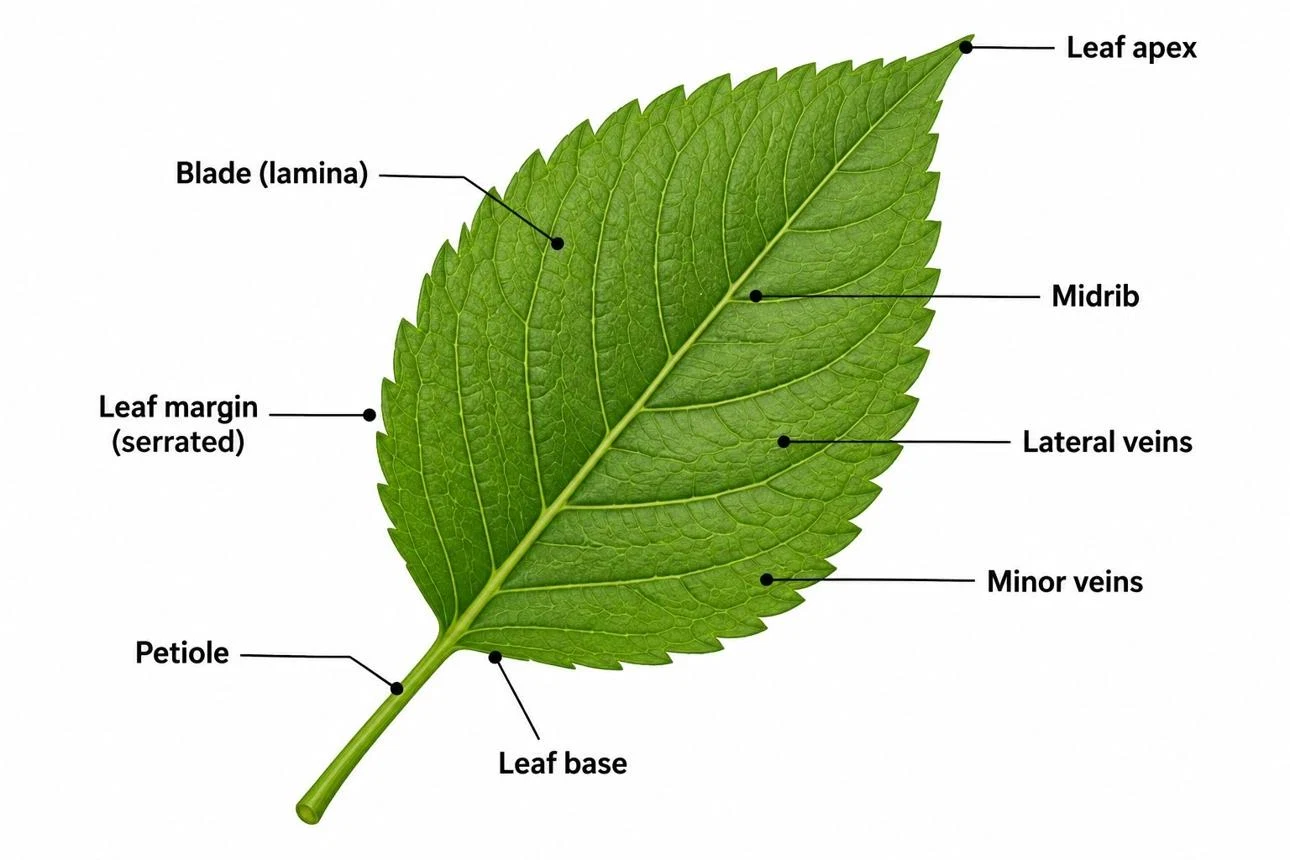
|
Leaf part |
Function |
|---|---|
|
Lamina or leaf blade |
Broad surface for absorbing sunlight |
|
Midrib |
Supports the leaf and contains conducting tissues |
|
Veins |
Transport water, minerals and sugars |
|
Petiole |
Attaches the leaf blade to the stem |
|
Leaf margin |
Outer edge of the leaf |
|
Leaf apex |
Tip of the leaf |
|
Leaf base |
Area where the blade joins the petiole or stem |
3. Internal structure of a leaf
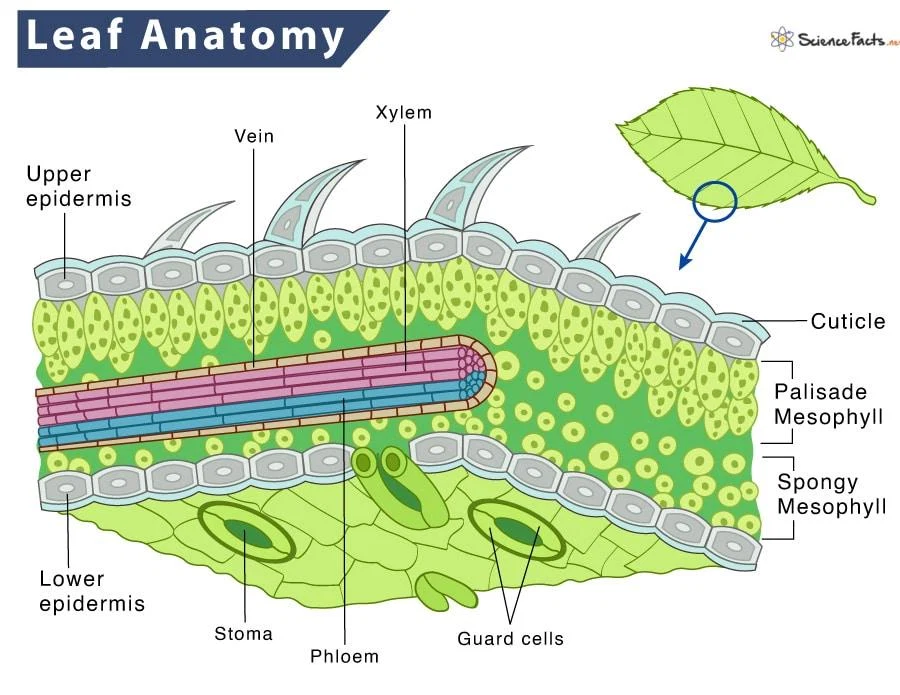
us.timacagro.com
Cuticle: A thin waxy layer that helps reduce water loss.
Upper epidermis: Protects internal tissues and generally allows light to pass through.
Palisade mesophyll: Contains many chloroplasts and is usually the main site of photosynthesis.
Spongy mesophyll: Contains air spaces that allow gases to move through the leaf.
Xylem: Transports water and mineral ions from roots to leaves.
Phloem: Transports sugars and other organic substances from sources to other parts of the plant.
Stomata: Small pores that allow gases to enter and leave the leaf.
Guard cells: Cells that regulate the opening and closing of stomata.
4. Adaptations of leaves to photosynthesis
Leaves have structural features that make photosynthesis efficient.
|
Adaptation |
Importance |
|---|---|
|
Broad, flat lamina |
Provides a large surface area to absorb light |
|
Thin structure |
Allows gases to diffuse over short distances |
|
Many chloroplasts |
Absorb light energy using chlorophyll |
|
Transparent upper epidermis |
Allows light to reach photosynthetic cells |
|
Numerous stomata |
Permit gaseous exchange |
|
Intercellular air spaces |
Promote movement of carbon dioxide and oxygen |
|
Extensive veins |
Supply water and transport manufactured food |
5. Meaning of photosynthesis
Photosynthesis is the process by which green plants use light energy, absorbed by chlorophyll, to manufacture sugars from carbon dioxide and water, releasing oxygen.
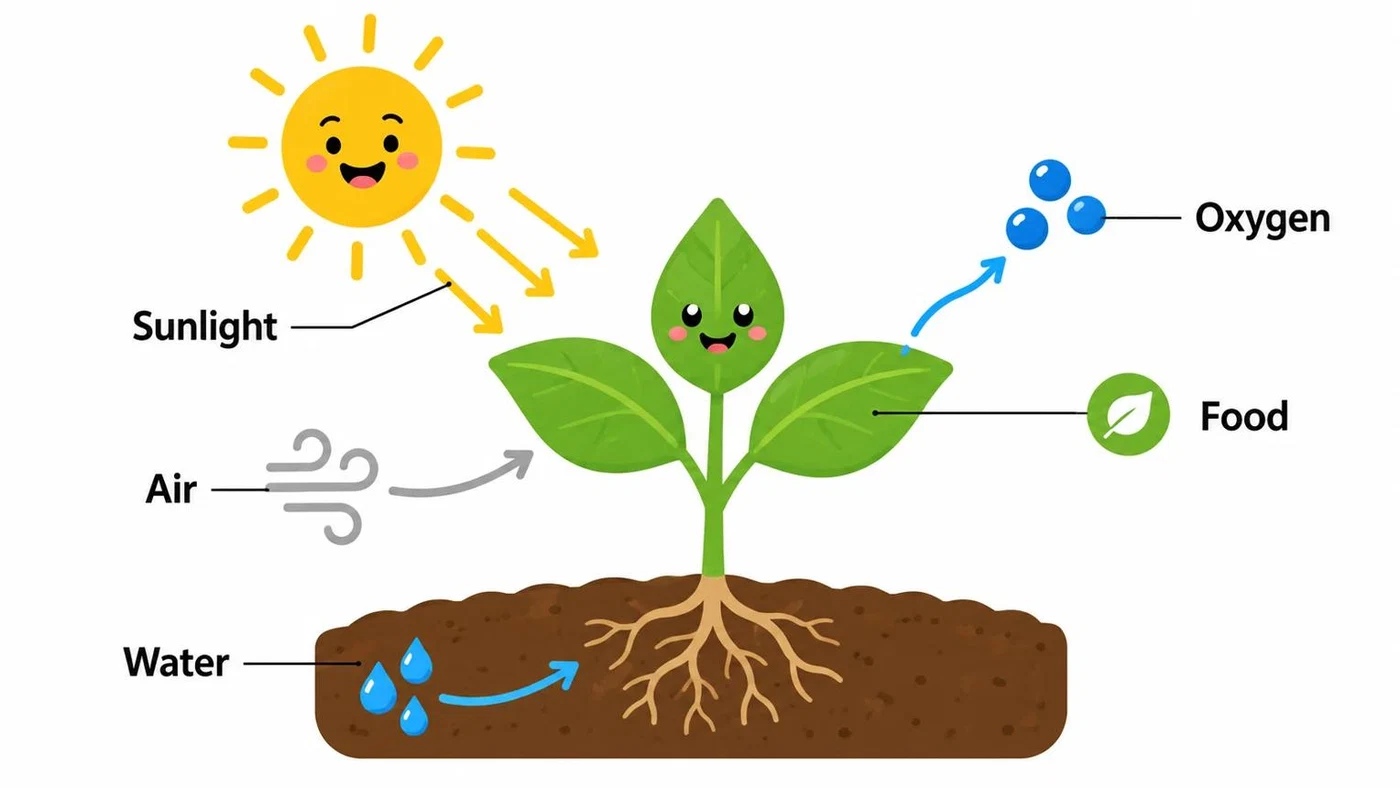
figviz.com
Word equation
Simplified chemical equation
6. Requirements for photosynthesis
Four major requirements are:
- Light: Supplies the energy needed for the process.
- Chlorophyll: Absorbs light energy.
- Carbon dioxide: Provides carbon used to produce sugars.
- Water: Supplies hydrogen and electrons used in photosynthesis.
Suitable temperature is also important because photosynthesis depends on enzymes.
7. Importance of photosynthesis
Photosynthesis:
- Produces organic food that supports food chains.
- Releases oxygen needed for aerobic respiration.
- Removes carbon dioxide from the atmosphere.
- Provides material for plant growth.
- Supports agricultural production.
- Stores solar energy as chemical energy in organic compounds.
8. Investigating conditions necessary for photosynthesis
Experiment A: Light is necessary for photosynthesis
Materials: Healthy potted plant, opaque paper or foil, clips, iodine solution, ethanol, beakers, hot water and forceps.
Procedure
- Keep a healthy potted plant in darkness for approximately 24–48 hours to reduce stored starch.
- Cover part of one leaf on both sides using opaque material.
- Put the plant in sunlight for several hours.
- Remove the leaf and the covering.
- Boil the leaf briefly in water.
- Place the leaf in ethanol heated using a hot-water bath to remove chlorophyll.
- Rinse the leaf in warm water.
- Add iodine solution.
Expected results
The exposed region turns blue-black, indicating starch.
The covered region remains yellow-brown, indicating little or no starch production.
Conclusion: Light is necessary for starch production during photosynthesis.
Experiment B: Chlorophyll is necessary
Use a destarched variegated plant with green and non-green regions.
Expose the plant to light and perform the iodine test.
Expected result: The green areas generally turn blue-black, while the non-green areas do not.
Conclusion: Chlorophyll-containing areas photosynthesise and produce starch under suitable conditions.
Experiment C: Carbon dioxide is necessary
A teacher may use two destarched plants enclosed in transparent containers. One container contains a substance that absorbs carbon dioxide, while the control has normal air. After sufficient light exposure, test suitable leaves for starch.
The plant deprived of carbon dioxide should produce much less starch than the control.
Safety: Ethanol is highly flammable. Never heat it directly over a flame. Iodine and carbon-dioxide-absorbing chemicals must be handled with teacher supervision.
Activity 2.1
- Draw and label the external structure of a leaf.
- Explain five adaptations of leaves to photosynthesis.
- Write the word equation for photosynthesis.
- Explain why a leaf is boiled in ethanol during the starch test.
- State four reasons photosynthesis is important.