
Definition
Holding tools are devices used to grip, secure, or support workpieces firmly during cutting, shaping, drilling, filing, gluing, or other operations.
Types and Uses of Holding Tools
|
Tool |
Description / Parts |
Main Uses / Tasks Performed |
|---|---|---|
|
Bench Vice |
Fixed to workbench; has two jaws (fixed + movable), handle, base. |
Holding wood/metal for sawing, filing, drilling. |
|
Hand Vice |
Small portable vice with two jaws and handle. |
Holding small items (wires, jewellery) for filing, shaping. |
|
G-Clamp / C-Clamp |
C-shaped frame with screw thread to tighten jaws. |
Clamping workpieces to bench or together during gluing/welding. |
|
Sash Clamp |
Long bar with movable head and fixed foot. |
Holding long pieces (door frames, table tops) during gluing. |
|
Pliers |
Long-nose, combination, flat-nose, side-cutting. |
Gripping, bending, twisting, cutting small wires/objects. |
|
Tongs |
Long handles with a pivot and gripping end. |
Holding hot objects (test tubes, metal pieces) safely. |
|
Clips |
Spring-loaded metal or plastic. |
Holding papers, fabrics, or light materials together. |
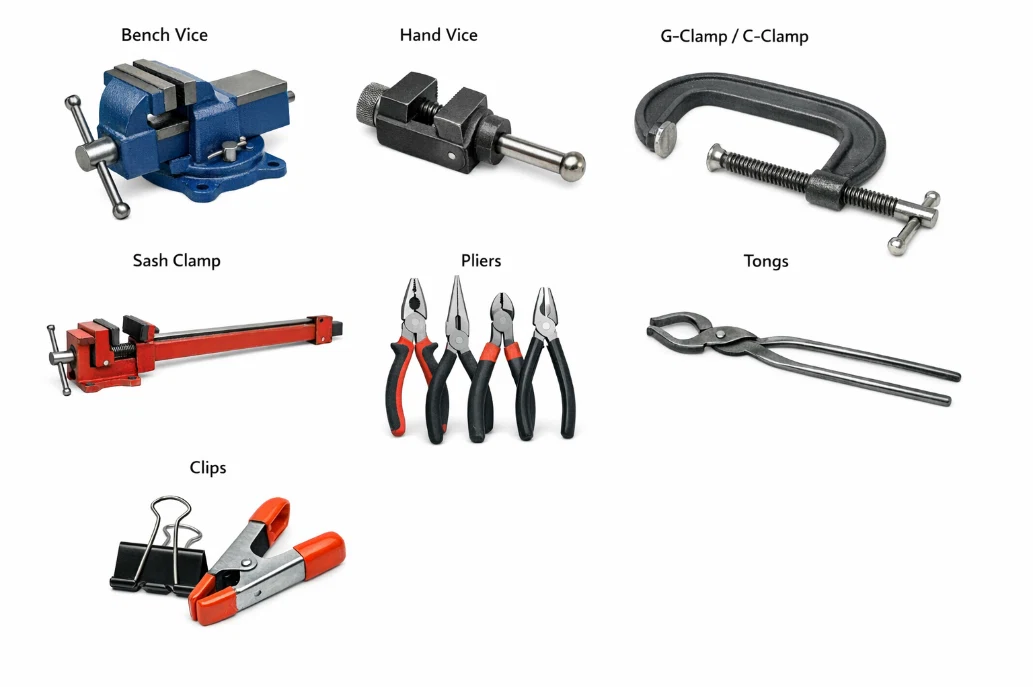
Figure 14: Image showing Holding tools
Selecting Holding Tools
Consider the task, material, and safety:
- Match tool size to workpiece size (large bench vice for big timber).
- Use smooth jaws for delicate/finished surfaces to avoid marks.
- Use tongs for hot materials to prevent burns.
Caring for Holding Tools
- Clean: Remove dust, grease, and metal shavings after use.
- Lubricate: Oil moving parts (screw threads, hinges) to prevent rust and sticking.
- Store Properly: Keep in a dry place, hanging or in a toolbox (avoid floor contact).
- Inspect: Check for cracks, worn jaws, or loose handles regularly.
Importance of Holding Tools
- Ensures accuracy and quality in production (carpentry, metalwork).
- Increases safety by freeing both hands and preventing slips.
- Supports trades and jobs (carpenters, mechanics, artisans).