
Sorry, we can not find any courses for this search.
You may want to check Our Hot Courses:
Free
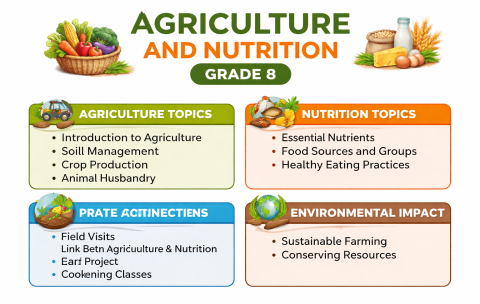
AGRICULTURE AND NUTRITION – GRADE 8
What you'll learn
By the end of the academic year, learners will be able to:
Strand 1: Conservation of Resources (Term 1)
1.1 Soil Conservation Measures
Describe and implement soil conservation methods (strip cropping, grassed waterways, stone lines, trash lines, soil bunds). Construct a farm model demonstrating conservation structures on a farm layout.
1.2 Water Harvesting and Storage
Discuss and practice water harvesting techniques (rooftop collection, shallow pans, ponds, tanks). Set up and maintain water harvesting structures for domestic and farm use.
Strand 2: Food Production Processes (Terms 1, 2 & 3)
2.1 Kitchen and Backyard Gardening
Explain the role of kitchen gardens in food security. Establish innovative gardens (multi-storey, container, wick, drip, tyre, sack) using locally available materials.
2.2 Poultry Rearing in a Fold
Describe poultry fold structures. Construct a fold using recycled materials and rear poultry, practicing feeding, watering, sanitation, and vaccination.
2.3 Crop Pest and Disease Control
Identify vegetable crops attacked by pests (punctured leaves, cut seedlings, curling leaves) and diseases (wilting, spots, rotting). Apply non-chemical control methods.
2.4 Preparation of Animal Products: Fish and Poultry Carcass
Explain importance of processing fish and dressing poultry. Process fresh fish (scaling, gutting, cleaning, salting, frying). Dress poultry carcass (beheading, defeathering, removal of offal, cleaning).
2.5 Preserving Milk and Meat
Describe methods of preserving milk (boiling, pasteurization, fermentation) and meat (drying, salting, smoking, refrigeration). Demonstrate simple preservation techniques.
2.6 Cooking: Preparing a Balanced Meal
Explain factors to consider in meal planning (age, health status, occasion, gender). Plan, cook, and serve a balanced meal using appropriate serving styles.
Strand 3: Hygiene Practices (Term 2)
3.1 Cleaning the Kitchen
Explain daily, weekly, and special cleaning routines. Carry out thorough kitchen cleaning to maintain hygiene and prevent food contamination.
Strand 4: Production Techniques (Terms 2 & 3)
4.1 Sewing Skills: Constructing Household Items
Identify types of seams (plain/open seams). Make seam samples and construct simple household items (lap bag, work bag, pillow case, cushion cover) using hand sewing.
4.2 Constructing Innovative Animal Waterer
Explain challenges with traditional waterers. Design and construct an innovative waterer for small domestic animals using recycled materials. Test and improve functionality.
4.3 ICT Support Services
Describe ICT support services in agriculture (weather forecast, veterinary, extension, market information, banking). Access online platforms responsibly and ethically.
Community Service Learning (CSL) Project (Integrated across terms)
Identify a community challenge (environmental degradation, food security, lifestyle diseases).
Design, plan, implement, and showcase a project that applies skills from Agriculture and Nutrition and other learning areas.
Free
Grade 2 Creative Activities Course
What you'll learn
Strand 1.0: Creating and Executing – Perform hopping in various directions, patterns, and combinations for improved agility and coordination; create detailed drawings and paintings using lines, shapes, colours, and textures; develop and maintain rhythm through body percussion, instruments, and voice while making repeating patterns; execute safe turning movements; design and construct mosaic artworks using local materials; create and perform simple melodies.
Strand 2.0: Performing and Displaying – Actively participate in and perform Western-style singing games with appropriate movements, costumes, and props; demonstrate controlled kicking for accuracy and distance; create plaited ornaments using recycled or natural materials; perform egg roll and swan balance activities for balance and body control; construct and play simple wind musical instruments; make three-dimensional models; sing a variety of songs expressively while displaying creations confidently in group settings.
Strand 3.0: Appreciation – Recognise and appreciate Western-style singing games and musical elements; demonstrate practical water safety awareness and environmental care; reflect on personal and peer creative processes.
Overall Competencies Developed: Creativity & imagination, communication & collaboration, self-efficacy, learning to learn, critical thinking, and appreciation of both Kenyan cultural heritage and global influences. Learners will internalise values such as responsibility, unity, respect, and love while addressing PCIs including safety, self-awareness, environmental conservation, and citizenship.
Free
Grade 1 Creative Activities Course
What you'll learn
Strand 1.0: Creating and Executing – Identify and perform basic physical movements (jumping, stretching, rhythm); create simple drawings, paintings, patterns, and melodies; improvise objects for creative activities; develop body agility, coordination, flexibility, and artistic expression.
Strand 2.0: Performing and Displaying – Perform Kenyan-style singing games and action songs; demonstrate throwing, catching, log rolling, and balancing skills; create paper crafts, models, and percussion instruments; display their creations confidently while collaborating in groups.
Strand 3.0: Appreciation – Recognise and appreciate different musical sounds; develop awareness of water safety and environmental care; reflect on and enjoy their own creative processes and those of others.
Overall Competencies Developed: Creativity & imagination, communication & collaboration, self-efficacy, learning to learn, critical thinking, digital literacy (where applicable), and appreciation of Kenya’s rich cultural heritage. Learners will also internalise values such as responsibility, unity, love, and respect while addressing PCIs including safety, self-awareness, environmental conservation, and citizenship.
Free
Religious Education Activities PP1
What you'll learn
Demonstrate basic moral, spiritual and ethical values
Show respect for self, others, God/Creator and the environment
Practise simple prayers, songs and stories from their faith
Free
Language Activities PP1
What you'll learn
Demonstrate basic listening, speaking, reading readiness and writing readiness skills
Communicate confidently in English and Kiswahili
Enjoy language games, rhymes, stories and songs
Free
Grade 1 English Language Activities
What you'll learn
Listen attentively and respond to simple instructions and stories
Speak clearly using simple sentences
Read short texts with understanding
Write simple sentences and short paragraphs
Free
Creative Activities PP1
What you'll learn
Develop gross and fine motor skills
Express creativity through art, music, dance and movement
Show coordination, imagination and self-confidence
Free
Environmental Activities PP1
What you'll learn
Explore and understand the immediate physical and social environment
Demonstrate awareness of safety, hygiene, nutrition and weather
Show care for plants, animals and surroundings (sustainability)
Free
Mathematical Activities PP1
What you'll learn
Use classroom skills to solve simple daily-life problems
Demonstrate basic number concepts, classification and measurement
Show interest in shapes, patterns and logical thinking
Free
Pre-Technical Studies (Grade 7, Kenya CBC – Junior Secondary School)
What you'll learn
By the end of Grade 9, the learner should be able to:
Communicate effectively using ICT.
Select and use tools and materials in the production of goods and services.
Use financial and entrepreneurial competencies for prudent decision-making.
Observe safety in the immediate environment to promote sustainable development.
Apply ICT skills in day-to-day activities.
Create awareness on career choices and pathways for self-development.